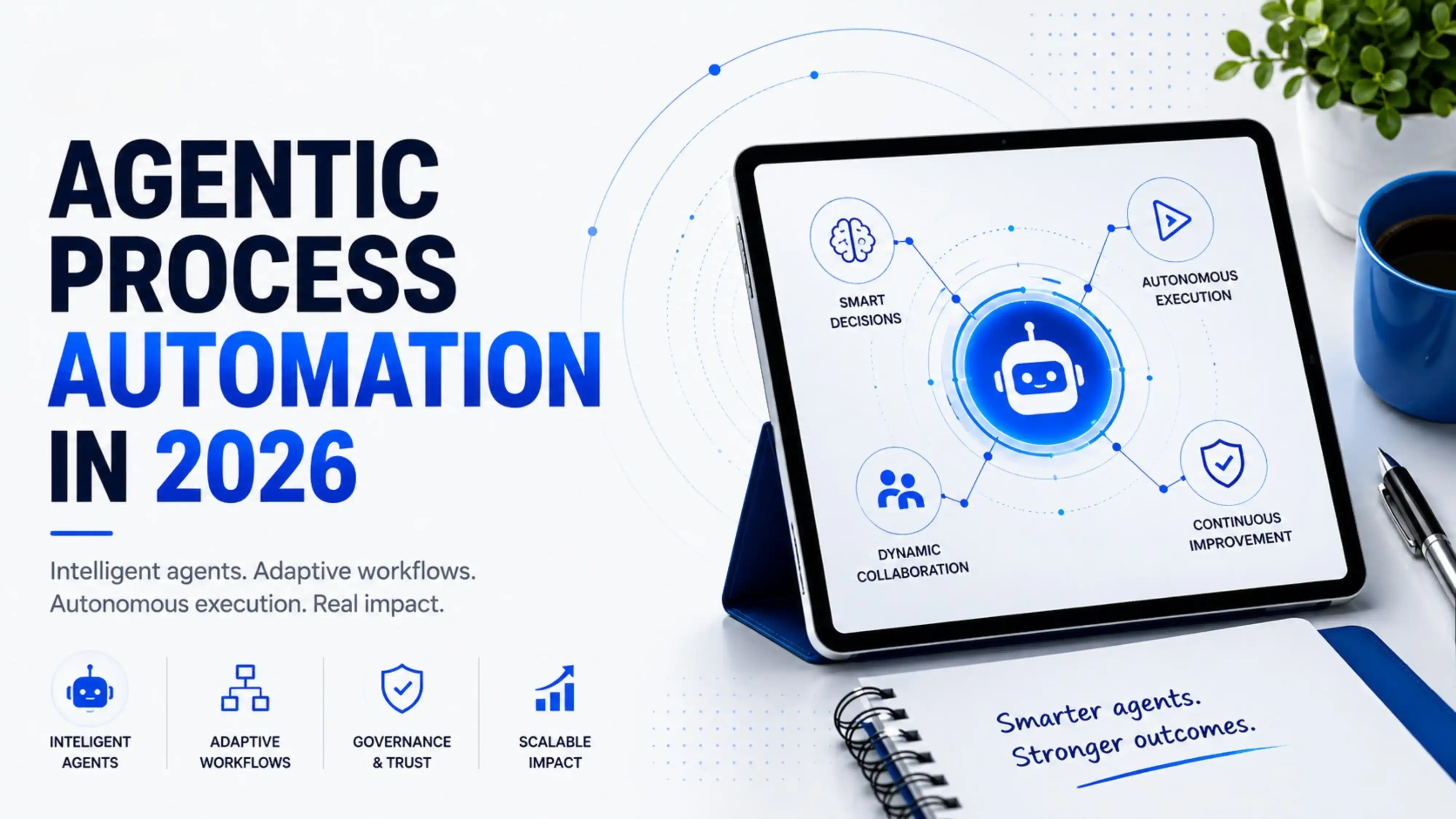
A Quick Summary
As of May 2026, the enterprise landscape has transitioned from the "LLM Rush" to the Agentic Era, where the focus is no longer on conversational assistants but on Agentic Process Automation (APA) Services. This shift represents a fundamental re-engineering of software from deterministic, rule-based instructions (RPA) to autonomous, goal-driven systems capable of reasoning through unprogrammed exceptions.
Table of contents
1. The Proliferation of Multi-Agent Systems (MAS)
The single-purpose agent is now considered outdated. The dominant trend is Multi-Agent Orchestration, where specialized digital coworkers collaborate under a central "Manager Agent."
The Manager-Worker Pattern
Instead of one model attempting to handle an entire process, a lead agent decomposes a goal and assigns specialized sub-agents for finance workflows, legal operations, compliance management, IT orchestration, and operational execution.
This hierarchical structure allows organizations to distribute tasks across domain-specific agents rather than depending on a single generalized model.
Real-World Enterprise Impact
Organizations such as Fountain have achieved:
- 50% faster screening.
- 40% quicker onboarding.
- Staffing cycles reduced to less than 72 hours.
These outcomes are driven through hierarchical multi-agent orchestration systems that accelerate enterprise execution at scale.
Parallel Execution Architecture
Modern APA systems use orchestrators to coordinate specialized agents working in parallel. Each agent operates with its own dedicated context before synthesizing results into a final output.
This architecture improves scalability, operational speed, task specialization, and workflow efficiency.
2. Standardized Interoperability: The "USB-C for AI"
Model Context Protocol (MCP)
Known as the "USB-C moment for AI," MCP has become the universal standard for connecting agents to enterprise tools, APIs, and organizational data. By April 2026, the ecosystem recorded:
- Over 97 million monthly SDK downloads.
- More than 5,800 available servers.
MCP now serves as a critical infrastructure layer for scalable APA deployments.
Agent-to-Agent (A2A) Protocol
The A2A protocol enables horizontal communication between specialized agents developed by different vendors. This allows systems such as Salesforce agents and Google agents to collaborate within a single end-to-end enterprise workflow.
3. Context Engineering and the "32K Cliff"
A major technical shift inside Agentic Process Automation (APA) Services is the move from prompt engineering toward Context Engineering.
Engineers have identified a "performance cliff" at approximately 32,000 tokens — commonly referred to as context rot — where model correctness drops significantly regardless of the advertised context window size.
Recursive Language Models (RLMs)
To bypass these limitations, Recursive Language Models process inputs up to two orders of magnitude beyond standard context windows by:
- Breaking prompts into snippets.
- Recursively calling themselves.
- Synthesizing structured outputs.
This architecture enables enterprise systems to process significantly larger reasoning workloads.
Dynamic Context Partitioning
Engineering teams are now separating:
- Static context (API specifications, coding standards, and enterprise policies).
- Dynamic context (real-time operational data, workflow states, and transactional information).
This separation enables prompt caching, lower token consumption, reduced latency, and improved scalability.
4. The Rise of Guardian Agents for Governance
Autonomous Governance Systems
Guardian agents have emerged as a specialized category within Agentic Process Automation. Their role is to monitor other agents in real time for:
- Compliance violations.
- Safety failures.
- Scope drift.
- Unauthorized behaviors.
These governance systems are becoming essential for enterprise-scale autonomous execution.
AI Firewalls and Deterministic Controls
AI firewalls now intercept tool calls at the infrastructure layer, enabling deterministic kill switches for high-risk operations such as:
- Financial transactions.
- Data deletions.
- Privileged system access.
5. The $500K/Month Hidden Billing Crisis
POPS: Financial Controls for AI
Agents now function as full-time digital engineers. Compute-intensive reasoning tasks can make a single agentic code review cost between $15 and $25 per review.
This has led enterprises to adopt POPS (Financial Controls for AI) frameworks to optimize infrastructure spending.
Strategic Model Routing
Large organizations such as Uber, where 95% of engineers actively use AI systems, are implementing strategic routing architectures that:
- Assign lightweight tasks to lower-cost models.
- Reserve frontier reasoning models for complex workloads.
This approach significantly reduces operational costs without sacrificing performance.
A single agentic code review can cost between $15–$25. Without POPS financial controls and intelligent model routing, enterprise AI bills can silently climb to $500K/month or beyond.
6. The May 2026 Production Landscape
While 80% of enterprise applications shipped in Q1 2026 now embed at least one AI agent, only 31% of organizations have successfully moved agents into full production.
This highlights the growing gap between experimentation and operational maturity.
Industries Leading Agentic Process Automation Adoption
- Banking and Insurance
47% production rate. Primary use cases include fraud detection, underwriting, and mid-office automation. - Software and Internet
44% production rate. Major focus areas include agentic coding, observability, and product analytics.
The Biggest Production Blockers
Despite rapid experimentation, 88% of agent pilots fail to reach production due to:
- Evaluation and observability gaps (64%).
- Governance friction (57%).
- Model non-determinism (51%).
These challenges continue to define the operational maturity curve of enterprise Agentic Process Automation.
Conclusion
From MCP interoperability and context engineering to guardian agents and financial governance, the Agentic Era is fundamentally reshaping how modern enterprises design, deploy, and manage intelligent automation systems.
As adoption accelerates, the organizations that successfully operationalize Agentic Process Automation will define the next generation of enterprise infrastructure.