A Quick Summary
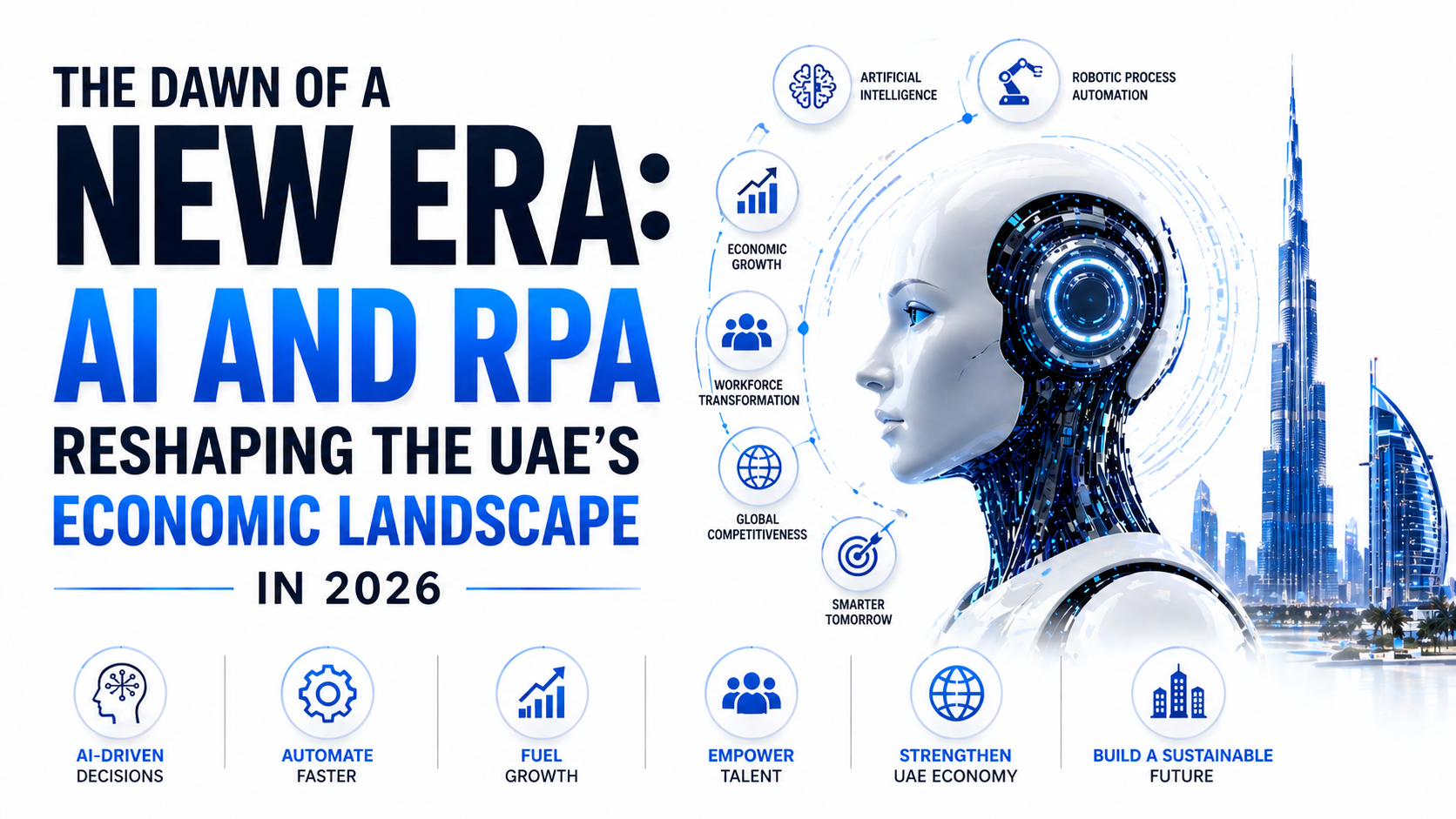
With the current month being April 2026, it is evident that the UAE has become one of the epicenters of technology in the world. On April 27th, the 3rd International Conference on Robotics and Automation kicked off in Dubai with the theme "Human–Robot Collaboration." This blog delves into the effects brought about by the integration of Artificial Intelligence (AI) and Robotic Process Automation (RPA).
Table of contents
A National Mandate: Vision 2031
The UAE's meteoric rise in the digital domain is underpinned by the National Strategy for Artificial Intelligence 2031, which seeks to establish the nation as a leader in AI technology. It envisions the creation of economic value worth approximately AED 335 billion.
Some of the key strategic priorities include:
- Creating a world-class reputation as a destination for artificial intelligence.
- Growing competitive advantage in priority sectors, including energy, logistics, health care, and tourism.
- Creating a favorable ecosystem for start-ups and foreign companies through an AI network across the country.
- Creating 20% of non-oil GDP from AI by 2031.
While several Western countries struggle with a piecemeal approach to AI adoption, the UAE's strategy is defined by exceptional central coordination, spearheaded by the world's first Minister of State for Artificial Intelligence. This has enabled a strong data-sharing mechanism critical to creating AI-enabled datasets.
Public Sector: Efficiency Redefined
Quantifiable Gains in Service Delivery
Implementation data reveals an average 42.6% reduction in processing times and a 35% decrease in operational costs across federal and local government entities. The Smart Dubai initiative alone has automated over 120 services, saving approximately 3.2 million hours annually.
Specific service improvements include:
- Visa Renewal Processes (Dubai): Time shortened from 10 days to 3.5 days (65% decrease).
- Business Licensing Processes (Abu Dhabi): Time shortened from 18 days to 2.8 days (84.4% decrease).
- Land Transfer Processes (Sharjah): Time shortened from 22 days to 5.1 days.
- Error Rates: Decreases in error rates above 70% have been achieved, gaining public confidence in government online processes.
The Framework of Success
The success in the public sector comes down to using an integrated approach involving both the 8-Step Change Model by Kotter and the Technology Acceptance Model (TAM). Change does not occur only thanks to new technology — organisations need to create urgency, build coalition, and make the technology user-friendly.
Private Sector Revolution: The Banking Powerhouse
Case Studies in Hyper-automation
- Mashreq Bank: Managed to automate 50% of its IT tickets, with bots resolving more than 10,000 tickets each month.
- HDFC Bank: Decreased loan processing duration from 40 minutes per application to 20 minutes.
- Overall Industry Effect: Banks using RPA Services have seen up to a 90% decrease in loan processing duration and 50% faster approval processes.
Use Cases for Finance
- Customer On-boarding and KYC: RPA bots compare customer information with financial data with minimal human input, leaving no margin of error.
- Fraud Detection: AI-powered bots detect fraudulent activities by analyzing transaction patterns.
- Account Payables: OCR-driven automation has eliminated the tediousness of accounts payable processing.
- Regulatory Reporting: Automation handles dynamic compliance requirements including VAT filing and Central Bank report preparation.
Difference Between Intelligent Automation (IA) and Traditional Robotic Process Automation
By 2026, one significant difference is drawn between Robotic Process Automation and Intelligent Automation (IA).
- RPA Services are best suited for tasks dealing with structured data, following simple rules, and offering ROI within 12 months of operation.
- Intelligent Automation integrates Robotic Process Automation with AI and ML to enable processing of unstructured data — such as emails and image files — and making cognitive decisions.
Firms shifting towards IA experience a 25–50% reduction in costs alongside a 20% boost in revenue for their fully AI-enabled processes. The hyperautomation market (IA) has risen above $56 billion as of 2024–2025.
Strategic Implementation: Choosing the Right RPA Services Partner in Dubai, UAE & GCC
Despite the benefits, global data shows that less than 30% of automation programs achieve full ROI. In the UAE, the failure rate is often linked to choosing partners who prioritize "selling bots" over sustainable discipline.
The "Procism" Philosophy for Success
Experts suggest that a successful Robotic Process Automation partnership must look beyond technology:
- Demand ROI Math: Partners should quantify rework hours and compliance penalties before signing a contract.
- Six Sigma Approach: Leading partners implement DMAIC (Define, Measure, Analyze, Improve, Control) to ensure waste reduction prior to scripting.
- Change Management: Within the UAE's multilingual work environment, the partner must convert technical success into employee behavior.
- Governance First: In a region with strict compliance (VAT, Central Bank), bots must be designed with escalation rules and validation frameworks.
Conclusion: The Future of Collaboration
As the Robotics 2026 conference highlights, the future is not about robots replacing humans, but about Human–Robot Collaboration. By delegating mundane, high-volume tasks to "Digital Workers" who never sleep and operate with 100% accuracy, human employees are freed to focus on high-value, revenue-generating functions.
From banks handling 2 million transactions per day to government organizations reducing licensing procedures by 84%, 2026 tells us one thing: RPA is the norm, but intelligence sets you apart. The UAE's dedication to the 2031 Strategy means it will always be fertile ground for such technologies.